

Blog, Physiotherapy
Hamstring Tear Treatment Explained: What Makes Recovery So Tricky?
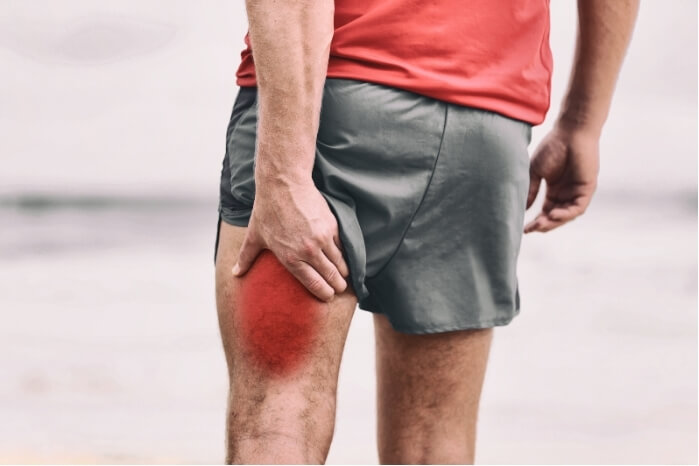
If you’ve ever torn a hamstring, you’ll know just how painful, frustrating, and slow the recovery can feel.
Whether it happened during a sprint, a game of footy, or even just slipping awkwardly — a hamstring injury is more than just a sore muscle.
In fact, hamstring tears are one of the most common and stubborn injuries in sport.
David McCawley is head physiotherapist for the Surfer’s Paradise Demons in the QAFL and has been treating sports related injuries for over a decade, and is well equipped to take your injury rehabilitation to the next level.
In this blog David discusses what makes hamstring tear treatment so difficult, and more importantly, how can you recover properly and avoid tearing your hamstring again.
Why Is Hamstring Tear Treatment So Tricky?
The hamstrings are a group of three muscles at the back of your thigh that work together to bend your knee and extend your hip.
They’re heavily involved in running, jumping, kicking, and sudden changes of direction — which is why they’re commonly injured in athletes and active individuals.
Here’s why hamstring tear treatment is particularly difficult:
🔁 They’re prone to re-injury
Research shows that one in three people who tear a hamstring will re-tear it within a year, especially if they return to activity too quickly or without full rehab.
🧬 They heal with scar tissue
Like other muscle tears, hamstring injuries form scar tissue as they heal. This tissue is less flexible and weaker than the original muscle, making it more vulnerable unless properly strengthened.
🦵 The hamstrings span two joints
Hamstrings cross both the hip and the knee, which means they’re under tension in multiple directions. This makes rehab more complex — they need to be strong and flexible across a range of movements.
🧠 They affect your movement patterns
After a hamstring tear, your body will naturally start to compensate — changing how you walk, run, or squat. These altered patterns can persist and lead to further injury, even once the pain has gone.
🧪 Not all tears are the same
Some hamstring injuries affect the muscle belly, while others involve the tendon (or even the bone in severe cases). Tendon-related tears, in particular, can take longer and require a different approach.
How Hamstring Injuries Can Be Managed and Improved
The key to recovering from a hamstring tear is comprehensive, progressive rehabilitation — not just rest.
Here’s how a physiotherapist can help:
🩺 Accurate diagnosis
We’ll assess the location and severity of the tear — sometimes with imaging — to determine the best treatment plan. Grade I (mild) injuries may recover in a few weeks, while Grade III (complete) tears can take several months.
🏋️ Targeted strength training
Rehab focuses on gradually rebuilding strength and length in the hamstring. Eccentric exercises (where the muscle lengthens under load) are especially important and backed by strong evidence.
🧠 Neuromuscular retraining
We address your brain-body connection to restore balance, stability and coordination — especially if you’ve been compensating.
🧩 Whole-body movement assessment
Often, other weaknesses or tightness (e.g. weak glutes, tight hip flexors, poor core control) contribute to hamstring strain. A good physio will address all of these, not just the injury site.
🏃 Return-to-sport planning
You’ll be guided through agility drills, sprint training and sport-specific activities, with objective testing to reduce re-injury risk.
Practical Tips to Protect and Strengthen Your Hamstrings
Ready to support your recovery — or prevent a hamstring injury in the first place? Start with these simple steps:
💪 Strengthen your hamstrings with eccentric exercises
Try Nordic curls, single-leg Romanian deadlifts, or hamstring sliders. These build the type of strength that protects against tearing.
🧘 Stretch — but at the right time
Avoid aggressive stretching too early in the healing process. Once cleared, include dynamic stretches like leg swings, or gentle static stretches post-exercise.
⏱️ Warm up properly
A thorough warm-up, including light cardio and dynamic movements, prepares your muscles for action.
🏃 Build sprint fitness gradually
Don’t go from zero to full-speed sprinting overnight. Progress your intensity and include sprint mechanics drills to reduce strain on the hamstrings.
🦵 Balance your training
Work on glutes, core, and quads to create a strong, supportive system around your hamstrings.
🧠 Listen to your body
Hamstrings often give warning signs before a major tear — like tightness, fatigue, or cramping. Take these seriously and back off before pushing too far.
In Summary
Hamstring tears are tough — not just because of the pain, but because they can easily come back if not properly treated.
The key is structured rehab, gradual progress, and addressing the root causes, not just the symptoms.
If you’re recovering from a hamstring injury — or want to avoid one altogether — book a session with our team.
We’ll help you heal right the first time and return stronger than before.
 |
Written By:
David McCawley (Senior Physiotherapist) Bachelor of Physiotherapy (honours) |