

Blog, Physiotherapy
Corked Muscle Physiotherapy: What to Do After a Hard Knock

If you’ve ever taken a hard knock during sport or collided with something solid, you might have walked away feeling like a muscle suddenly “locked up.”
Athletes often describe this as a corky or corked muscle — but what’s actually happening beneath the surface?
As a Sports Physiotherapist for almost a decade looking after professional, international athletes and currently head physio for a senior QAFL team, M Physio’s senior physiotherapist David McCawley is well equipped to help you manage all manner of soft tissue injuries, especially corked muscles.
What Is A Corked Muscle?
A corked muscle occurs when a forceful, direct impact drives the muscle into the bone underneath.
Think of a stray knee smashing into your thigh during a footy game or a fall onto a firm surface. Instead of overstretching (as in a strain), this is a compression injury — the tissue is squashed, not pulled.
When muscle fibres and tiny blood vessels are crushed, bleeding begins inside the muscle. That internal bleed creates pressure, swelling, stiffness, and the deep, bruised ache people recognise instantly.
In more severe ‘corkies’, the muscle can feel almost board-like because of the pressure building within the tissue.
Although common — especially in contact sports — a neglected corked muscle can leave behind persistent tightness or reduced strength.
Early care really does make a difference and correct diagnosis and management can be the difference of returning to the activity earlier and with less chance of re-injury.
Muscle Strains and Tears — How Common Are They Really?
To understand how often these injuries show up, it helps to zoom out:
- Analyses of major global athletics championships show that muscle injuries make up roughly 40% of all reported injuries, with the thigh (both hamstring and quadriceps) topping the list.
- Hamstring injuries alone accounted for 17% of all injuries in those competitions — making them one of the most frequently affected muscle groups.
- In Australia, hamstring and thigh injuries remain a major issue with approximately 15% of athletic injuries involve hamstring strains or tears, particularly in sports demanding sprinting, kicking, or quick directional changes.
- A large-scale dataset of more than 270,000 player-matches in Australian team sports recorded:
- 1932 hamstring strains/tears
- 418 quadriceps injuries
- 458 calf injuries
This translates to approximately less than 1% chance per match of a player sustaining a hamstring strain or tear.
Collectively, these numbers highlight something important: thigh-muscle injuries are widespread across Australian sport, and proper management (and prevention!) is essential.
What To Do Early (First 24–48 Hours After a Corked Muscle)
Because a corked muscle involves bleeding into the tissue, the early response is all about limiting that bleed and keeping swelling under control.
- Rest and protection
Avoid stretching or massaging the area early on — both actions can increase bleeding in the first phase.
- Short, targeted ice
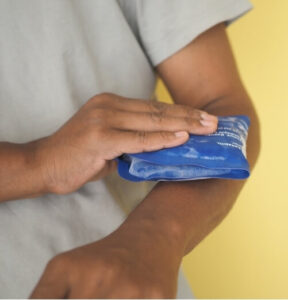
Apply ice for 15–20 minutes at a time, several times throughout the day. This helps control swelling and dulls the pain.
- Compression
A firm elastic bandage or compression sleeve helps keep swelling in check.
- Elevation
If you can, keep the injured limb elevated above the heart to reduce fluid pooling.
These simple steps set the foundation for a smoother and faster recovery.
How Physiotherapy Accelerates Healing and Prevents Recurrence
Physio can be the difference between a muscle that settles quickly and one that lingers for weeks.
Here’s why:
Clinical assessment
A physiotherapist evaluates the severity of the contusion, checks for deeper complications (e.g., significant haematoma), and builds a tailored rehab plan around your activity goals.
Restoring mobility — carefully
Once swelling starts to decrease, gentle, pain-free movement helps prevent the muscle from tightening excessively. The key here is progression at the right pace, something your physio will guide precisely.
Soft-tissue treatment — at the correct stage
Hands-on techniques (massage, trigger-point work, myofascial release) can be incredibly helpful once the bleeding has stopped, but doing them too early can worsen swelling. Timing matters.
Strength rebuilding
You’ll work through targeted strengthening to restore power, endurance, control, and flexibility. This step is essential before you return to running, sport, or heavy activity.
Return-to-play guidance
Athletes benefit enormously from a structured progression. Physios can test strength and function, monitor load, and introduce sport-specific drills.
This is especially important because muscle injuries — particularly hamstrings — have high re-injury rates if rehab is rushed or incomplete.
The Bottom Line
A corked muscle might look like a simple bruise on the outside, but inside, it’s a genuine tissue injury that deserves proper care.
With early protection and a well-planned physiotherapy program, most people make a full and speedy recovery.
Given how common thigh-related injuries are in Australian sport, treating a corky seriously is a smart move.
If the pain seems too severe, isn’t improving within a couple of days, or keeps happening, checking in with a physiotherapist is the best way to get back to moving freely, comfortably, and confidently.
 |
Written By:
David McCawley (Senior Physiotherapist) Bachelor of Physiotherapy (honours) |