

Blog, Physiotherapy
Core Stability Exercises for Lower Back Pain – What The Research Says

Lower back pain affects millions globally, often becoming chronic and disabling. But simply strengthening muscles isn’t enough.
Over the past four years, high-quality clinical trials and meta-analyses have focused on the effectiveness of core stability exercises for lower back pain targeting deep spinal muscles and motor control with encouraging results.
Why Core Stability?
“Core stability” refers to activating deep muscles like the transversus abdominis, multifidus, pelvic floor, and diaphragm to support spinal posture and movement.
When these muscles activate effectively, they provide a solid foundation that helps distribute load and reduce strain on the spine.
Top Evidence: What the Research Shows
- Smrcina et al. (2022) conducted a systematic review of 14 randomised controlled trials (RCTs), concluding that core stabilisation exercises significantly reduced pain and improved function in non‑specific chronic low back pain (NSCLBP), with moderate-quality evidence.
- Hlaing et al. (2021) compared core stability exercises to general strengthening in people with subacute NSCLBP. They found significant improvements in proprioception, balance, muscle thickness, pain, and disability in the core training group.
- Le Ge et al. (2022) studied older women (60+) with chronic back pain. After 4 weeks of core training, participants had significant reductions in pain (VAS), improved disability (ODI), balance, walking speed, and increased transversus abdominis thickness versus controls.
- Khaledi & Gheitasi (2024) published an RCT comparing isometric vs isotonic core training in NSCLBP patients over 8 weeks. Both regimes reduced pain and disability, demonstrating clinical benefit.
- Rajabi et al. (2023) showed that adding real-time ultrasound biofeedback to core stability training improved pain, function, and muscle control more than generic core exercise alone.
Try These Evidence-Based Core Exercises
These four core stability exercises for lower back pain are supported by the literature above and widely used in clinical practice:
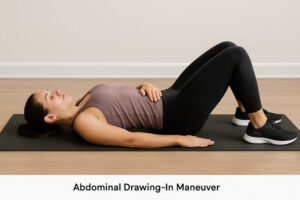
1. Abdominal Drawing-In Maneuver (ADIM)
How: Lying supine with knees bent, gently draw your belly button in toward your spine without movement. Hold 5–10 s, repeat 10×.
Why: Activates the transversus abdominis—a key stabiliser trained across many studies.
2. Bird-Dog
How: On hands and knees, slowly extend opposite arm and leg, keeping hips level. Hold 5–10 s ×10 reps per side.
Why: Improves coordination and motor control; part of the “McGill Big 3”.

3. Side Plank (Knee-Modded)
How: Side-lying with knees bent, support on forearm, lift hips into a straight line from shoulder to knees. Hold 10–20 s × 3–5 reps each side.
Why: Targets the obliques and quadratus lumborum; improves endurance and trunk stability.

4. Dead Bug
How: Lying supine, arms up, knees bent. Slowly lower opposite arm and leg, keeping your back flat. Do 10–15 reps each side.
Why: Trains deep core control with coordination; used clinically for proprioceptive outcomes.

Maximise Results: Simple Tips
– Control beats reps: Focus on smooth, precise movements.
– Be consistent: Aim for 3 sessions per week, over at least 6–8 weeks.
– Isometric or isotonic? 2024 RCT shows both styles work well.
– Biofeedback helps: Real-time ultrasound enhanced outcomes in a RCT.
– Integrate balance training: Especially important for older clients—studies show core drills help balance too.
Takeaway
Core stability exercises for lower back pain—based on quality research—is a safe, effective way to reduce pain, improve function, and enhance control in people with lower back pain.
These exercises activate deep spinal stabilisers, aid motor control, and help re-establish foundational muscle support.
At M Physio, we offer personalised programs combining core control, biofeedback, strength, and balance to rebuild spine health.
Ready to take the next step? Book a session today and let’s develop a plan suited just for you.
 |
Written By:
Mattias McAndrew (Head Physiotherapist) Bachelor of Physiotherapy (Hons) |
References
Smrcina, Z., Woelfel, S., & Burcal, C. (2022). A Systematic Review of the Effectiveness of Core Stability Exercises in Patients with Non‑Specific Low Back Pain. International Journal of Sports Physical Therapy, 17(5), 766–774. https://doi.org/10.26603/001c.37251
Hlaing, S. S., Puntumetakul, R., Khine, E. E., & Boucaut, R. (2021). Effects of core stabilization exercise and strengthening exercise on proprioception, balance, muscle thickness and pain‑related outcomes in subacute NSLBP. BMC Musculoskeletal Disorders, 22, 998. https://doi.org/10.1186/s12891-021-04858-6
Le Ge, H., Huang, H., Yu, Q., et al. (2022). Effects of core stability training on older women with LBP: RCT. Eur Rev Aging Phys Act, 19, 10. https://doi.org/10.1186/s11556-022-00289-x
Khaledi, A., & Gheitasi, M. (2024). Isometric vs isotonic core stabilization in chronic NSCLBP: RCT. Anesth Pain Med, 14(1):e144046. https://doi.org/10.5812/aapm-144046
Rajabi, S. M., et al. (2023). Real-time ultrasound–based core stability exercise in chronic NSLBP: RCT. BMJ Open, 11, e047317. https://doi.org/10.1136/bmjopen-2021-047317